Better Careers for Better Care: Building our proactive programme

Better Careers for Better Care: Building our proactive programme

In this blog, our Programme Development Lead Holly Baine reflects on the first year of the Better Careers for Better Care programme grants and shares the Foundation’s plans to build on what has been learnt and achieved so far.

It is now just over a year since we made the first grants through Better Careers for Better Care, the Foundation’s first proactive grant-making programme. 

We made eight grants through an open call focused on transformation within adult social care, and in particular on workforce development and career progression opportunities. We based our funding priorities on what we had heard from the sector through a period of learning and consultation. 

You can read more about the insights we gained from the open call here, and the grants that were made through the open call here and here.

This is the first time the Foundation has taken a strategic and collaborative approach in one of our priority areas, exploring how our limited resources can have more impact. Our sister organisation, The Rayne Trust, is now taking the same approach through the Where People Meet programme, funding into community centres. 

You can learn more about our Director Crispin’s reason for taking this approach in this blog.

The first year of funding

The open call for expressions of interest closed in early 2024, receiving 48 bids for funding from across England. An assessment panel, including External Advisers with lived and learned experience, shortlisted proposals to take to trustees for decision in June and September that year, allocating the full £2 million designated pot.

Six of the grants are place-based, where the funded work creates career progression or training opportunities. In all six programmes of work, commissioners are working alongside providers, seeking to capture impact in order to embed and sustain the opportunities. 

We made two grants to national organisations supporting and enabling those working in social care to share their stories, shift the narrative, and influence both policy and strategic decision-making at a national level.

The partner organisations from the eight programmes of work have formed an engaged and supportive Community of Practice (CoP) that meets quarterly to share updates, successes and challenges. 

Through the CoP, we have identified themes across the programmes of work, and we have held working groups with grant partners to explore them in more depth. Themes have included care worker participation, healthcare delegation, outcomes-focused commissioning, leadership, and value and recognition of social care.

The CoP has created the space for grant partners to build relationships across different parts of the care sector, to learn from each other and act as critical friends as they seek to address the many challenges facing the social care workforce. 

For us at the Foundation, being alongside the grant partners as they deliver the work has provided invaluable learning which has shaped the next iteration of the programme. We are very grateful for the trust and candour of all those involved.

Building on what we have learnt so far

Being alongside grant partners as their programmes of work have rolled out has taught us a huge amount. Grant partners have higlighted the value of independent and flexible funding which allows colleagues to pivot as they learn and respond to evolving landscapes at the local, regional, and national levels.

At the start of the programme we created an impact framework with our learning partner Bean Research which focuses on outcomes and articulates what we hope to achieve across the funding. We are excited to share our first-year learning report with those in both funding and social care spaces towards the end of 2025.

We have also begun to utilise our position as a funder to convene and have seen the value of doing so without a specific agenda. 

In November 2024, alongside the Joseph Rowntree Foundation, we brought together a group of stakeholders from across the social care sector to explore what a powerful care workforce would look like and what we can do to help achieve this. This both built our understanding of the issues and supported others to make connections and hear different viewpoints.

The staff team has shared our learning with our trustees on an ongoing basis. Given the momentum of the current grant-making programme and the opportunity presented by the government’s focus on reform of adult social care, there is support across the Foundation to build further on the Better Careers for Better Care programme.

As such, in March 2025 the Board agreed to the development of strategic grants in the devolved nations, a further open call focused on developing and embedding cultures of collaboration to support workforce development, and to the Foundation taking a more active role in convening leaders in social care.

Grants in Wales and Scotland

Due to the devolved nature of health and social care, the 2024 open call was only open to organisations working in England. However, as a UK funder, it was always our ambition to also fund in Wales, Scotland and Northern Ireland. We are delighted that in 2025, trustees agreed strategic grants in Wales and Scotland.

In March, we made a grant to Social Care Wales to support their work to embed positive cultures within adult social care. The work is in partnership with Care Inspectorate Wales and builds on the recently launched Supporting Positive Cultures Guide to help social care leaders and managers build and grow positive cultures in their organisations. Learn more about the work here.

In June, we made a grant to the University of Stirling in partnership with the IMPACT Centre. Building on a 12-month ‘Demonstrator’ project that brought together strategic partners across Scotland, the Stirling team will now move into an implementation phase, with the aim of shifting the narrative at a systems level. The team is working collaboratively with ADASS, Social Care Future and FrameWorks UK to ensure similar work is aligned across Scotland and England.

​A further open call

Through discussions with current grant partners and other key sector stakeholders, it has become clear that the complexity of commissioning and provision, and the transactional, competitive and/or hierarchical relationships within adult social care, act as significant barriers to achieving and sustaining change.

In response to this, trustees have agreed to a further open call focused on developing and embedding the cultures of collaboration needed to enable and sustain career opportunities for care workers.

Trustees have allocated £900,000 to the open call and we envisage making a further five grants. The open call will be live in early 2026 and we will seek proposals that run for up to two years to align with both our current reporting timeline and that of the Casey Commission.

As with the first open call, we will seek support from External Advisors in the assessment process, and we will work collaboratively with shortlisted partners to develop the proposals for Board. Grant partners will join the established Community of Practice and we will caputre outcomes and learning as part of the evaluation by Bean Research.

Convening

Through our grant-making and relationships with key stakeholders, we have built our understanding of workforce development and the challenges that face adult social care more broadly. We can also see that there is added value in the Foundation acting as a convener of others.

While we care deeply about the quality of care available to people and believe passionately in the value of carers, we know we don’t have the answers to the challenges the sector faces. As an independent funder, we sit on the outside and are therefore able to provide a neutral space for discussion across different parts of the sector. We will develop this work in collaboration with others in 2026.

In September this year, we brought together the funders we know already invest in adult social care to build a shared understanding of our current activity and to identify opportunities for collaboration. 

Ultimately, we would like to engage a broader group of funders so that we can illustrate how investing in the adult social care workforce can enable funders to achieve impact in their priority areas. 

For us, we believe investing in the care workforce will improve the experience of people in later life and their carers. For others, they may achieve impact in advancing social, racial and gender justice, tackling poverty, or supporting migrant workers, for example.

Upcoming ways to engage

We are delighted that by December we will be able to share the first-year learning report from Bean Research. The report will share progress towards the outcomes we established through the impact framework and highlights from our programme partners. 

In early 2026, we will host a series of webinars, in which grant partners will delve into some of the themes emerging across the funded programmes of work and share their experience and insights.

We will also run information webinars on the open call opportunity once this is launched, to share more about what we are seeking to fund and answer potential applicant’s questions.

If you would like to be kept up-to-date with any or all of the above opportunities, please email Programme Development Lead, Holly, to be added to the mailing list – hbaine@raynefoundation.org.uk
Reflections on our new strategy

Reflections on our new strategy

In this blog, Susan, Deputy Director, shares the thought processes which go on behind our public grant guidelines and reflects on what is important to her and her grants team as we seek to become more strategic in our work.

Within the grants team, we have been reflecting on how our way of working is changing since we launched our new strategy last year. In August 2024, we published our intention to bring a more pro-active and strategic approach to our work, along with a more focussed set of guidelines, to help us have greater impact across a smaller range of topics. We envisaged this would create more space to build relationships and seek out the work we want to fund. The reality has been somewhat more mixed.

Difference in approach across our programme areas

The thread across all our grant-making is that we fund work which approaches issues differently, enables innovation and has potential for wider application, adding to sector expertise and leadership.

Each of our programme areas is starting from a different place. With children and young people’s mental health and wellbeing, we have a strong history of grant-making to draw upon. We have already been funding great work supporting children and young people who are care-experienced and have developed relationships with a wide range of excellent charity partners who we are learning from. Our work on early years is newer and we are still refining where our focus will be; we have recently been exploring the needs of new parents who have experience of the care system.

Better Careers for Better Care, part of our later life programme, was launched from the outset as a strategic and collaborative programme. We are proud of the way that we have listened to and worked with the sector to explore where the barriers are in supporting the care workforce’s professional development. We are excited by the grants we have made to different types of organisations, including local authorities, an NHS Trust and even one commercial provider, testing new ways in which grant funding might help these organisations overcome the barriers they face in making change and ultimately improve the quality of care for people in later life. We are also drawing on expert advisors, convening, providing shared learning opportunities and evaluating the work carefully.

While Better Careers for Better Care is thinking about the social care workforce, our open grants programme in later life focuses on improving care through community approaches. We are interested in how people drawing on care and support in later life, along with their carers and the organisations providing care, might come together to strengthen and increase access to a network of support at the community level. This programme only reopened in December so it is early days; our only observation is that it is unlikely that any one organisation has the whole solution and so we hope to see more collaborative proposals.

With refugees and asylum seekers, this is a new area of focus for us as a Foundation, although we have made occasional grants for this group in the past. We have learned that the sector is made up of a small number of large organisations and lots of small and medium-sized organisations. This makes things interesting in terms of thinking how and where we can fund that has potential to have wider ripples across the sector. Particularly against a backdrop of what has been a challenging policy environment for many years. Nonetheless, we already have some relationships with key employment and specialist mental health organisations on which to build. We expect to make more small grants (for us £20,000 and under) in this sector than we would normally, recognising the number of smaller organisations.

The arts and creativity remain a strong theme across all of our programmes and we are keen not to lose sight of this as we narrow our focus. We will continue to fund arts and social change organisations which challenge current thinking on how best to connect with and support people in our priority groups.

Keeping an open application process

We are committed to keeping an open grants programme so that we do not miss the great ideas we might not find through our own research and relationships. However, we also need capacity to build our understanding and relationships within our priority areas so that we can become a strategic partner.

The move to online applications and an expression of interest approach has helped us to reduce the time it takes to enter and assess applications; we hope it is also a simpler and less time-consuming process for you, our applicants. Despite this, the numbers of applications have nearly doubled – rising from 50-60 per month in 2023-24 to over 100 per month in 2024-25. We can see clearly for the first time those applications which are outside of our priority areas; sadly, approximately 20% of everything we receive does not serve one of our priority groups and is therefore ineligible. We are also rejecting 85% of all applications, the most common reason being that the proposal will not deliver the wider impact that we seek. We acknowledge that the current funding environment is extremely difficult for many voluntary and community organisations. We know that many funders are tightening their criteria but equally want to be as clear as possible so that we do not waste your time.

With that in mind, we are evolving our thinking, based on the many applications received since August last year, about things which are less likely to be funded by us and how we communicate this effectively.

What are we looking for from you when we talk about wider application?

We know that no one organisation has the solution to any given problem. We are therefore looking to fund organisations who know what else is going on nationally and how their work adds to learning about what works. You will not just be providing a good local or national service but will be challenging how things are done and actively sharing learning beyond your organisation or place. If your work is local, your ambition will be national. If you are a national organisation, you will be seeking funding to do more than business as usual.

Successful applicants will be actively engaged with making change specifically for our priority groups. If your primary objective is to serve a wider cohort of people but you have small numbers of people with care experience, or people in later life, or refugees, or indeed offering a service which encompasses all three, then we are probably not the right funder for you. There will of course be exceptions to this but it is hard to define exactly where we might see them.

If your organisation has been running its service for a number of years, you will be able to articulate clearly the change that you are hoping to make to take this work to a new level, and how this has potential to transform thinking about how people in our priority groups are supported.

Improvements to our advice and guidance

We know that we need to find a way to communicate this thinking as clearly as we can and will be making some revisions to our guidance in the coming months. We have been giving some thought to other ways we might improve our advice-giving and in the early autumn hope to test out a webinar in which we can speak to you about your particular queries. We also encourage you to ring us for a conversation if you are unsure about applying, particularly if you feel that your work might be at the edge of our criteria.

‘Where People Meet’: No one need be alone

‘Where People Meet’: No one need be alone

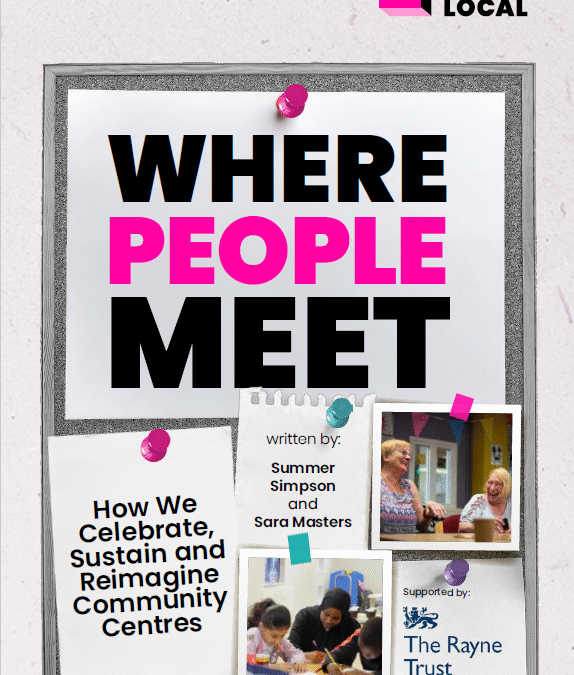
Following our series of blogs reflecting on the ‘Where People Meet’ report, we spoke to Hon Robbie Rayne, Chair of the Rayne Trust, to hear about where his idea for the Where People Meet programme came from, and what he wants to achieve through the open grants programme
The reason behind this fund is simple: we saw a growing need with so many people feeling deeply lonely, even while surrounded by others. 
We’re living in an age where technology connects us virtually, yet many of us are more isolated than ever. This programme is about returning to our roots – genuine human connection. 
I believe we need to return to the habits of small communities, caring for the lonely, the sick and our children, and sharing life’s expected and unexpected events. 

Community centres are essential spaces for human connection. Places where people can walk in and feel safe, share their challenges, and access support. In an increasingly isolated society, these spaces matter more than ever. But to truly serve their purpose, they must be properly resourced and funded. As the report highlights, areas without accessible places to meet often face poorer social and economic outcomes.  

At Rayne, a core part of our work has always been about building bridges; supporting initiatives that bring people from different backgrounds, communities, and walks of life together. We were proud to be early supporters of initiatives like Men in Sheds, which tackled loneliness head-on and scaled nationally We have also done some great work in the past with partners such as Place2Be and Imperial College. Community centres are uniquely positioned to foster connection across social divides, enabling shared understanding and helping build social mobility. The Where People Meet report reinforces the role of these spaces in creating stronger, more cohesive communities.

Through the open call, we want to support organisations in disadvantaged parts of the UK that are working to enhance multi-use community spaces. These spaces will deliver broad, positive benefits for local people by improving wellbeing, fostering inclusion, and addressing particular local needs through collaboration and innovation. 
We’re particularly focused on identifying and supporting community leaders, those who don’t just talk, but take action, and inspire others to do the same. Over the years, we’ve learned that real change happens when communities lead. You can’t impose solutions; they must come from within.  

The knowledge gained through the open call will inform the development of a larger fund, supporting our ambition to kick-start long term investment in community centres from a range of funders. Our role has never been to do everything ourselves, but to get things moving. Now, we need others to join us. 

‘Where People Meet’: Creating community ownership

‘Where People Meet’: Creating community ownership

In the second of our series of blogs reflecting on the ‘Where People Meet’ report, Sam Kirkby, Manager of the Sutton Centre in Bradford, articulates why physical assets are so important for communities and shares his main takeaways from the New Local research.

As long as humans have existed, we have found common spaces to gather. From market squares to trading halls, institutes to public houses, village halls to religious buildings – and community centres. The need to connect with others and find belonging in communities isn’t something new. 

Where People Meet, a new report from New Local and the Rayne Trust, isn’t about a big, shiny, new concept. It’s about recognising our need for spaces that represent local communities across the UK, for places that people collectively call ‘theirs’.

During the pandemic, as our movements and freedoms were restricted, the need to find support on our doorsteps and within our neighbourhoods became increasingly clear. Now we live in an age of ‘permacrisis’, where local support is more vital than ever.

Through this research, New Local and the Rayne Trust have gathered and amplified local people’s voices alongside those of statutory services, funders, policy makers, and community centre frontline staff to create a vision for the future – how we can dream up, shape and build high quality, well-resourced community centres that are at the heart of communities across the country.

This vision recognises that spaces like community centres that support local people are not a ‘luxury’, but a must have if we want to see communities across the country thrive and develop.

The take away piece from this report for me is that communities need a physical asset where they can access support and build connections. In this digital era, we are told that we are more connected than ever before and yet more people are experiencing social isolation. Community centres create opportunities for memories to be made, fostering connections between parents and children, older people, young people, professionals and organisations.

We all have a desire to belong. Your local community centres is a place where you can contribute, a place where you can be yourself, and a place where you belong.

The Rayne Trust
Privacy Policy

This website uses cookies so that we can provide you with the best user experience possible. Cookie information is stored in your browser and performs functions such as recognising you when you return to our website and helping our team to understand which sections of the website you find most interesting and useful.

Please see our privacy policy.